Arslanga insight
Cross-border growth
What Turns an Ageing Trend Into a Market?
An ageing population creates growing needs for care and support. For businesses, the question is whether an identifiable customer can fund a service, a capable provider can deliver it and the result is strong enough to justify continuing.
Songül Arslan is a board member of De Chinese Brug (DCB). She delivered the presentation discussed in this article in that capacity. The analysis that follows is her independent work through Arslanga.

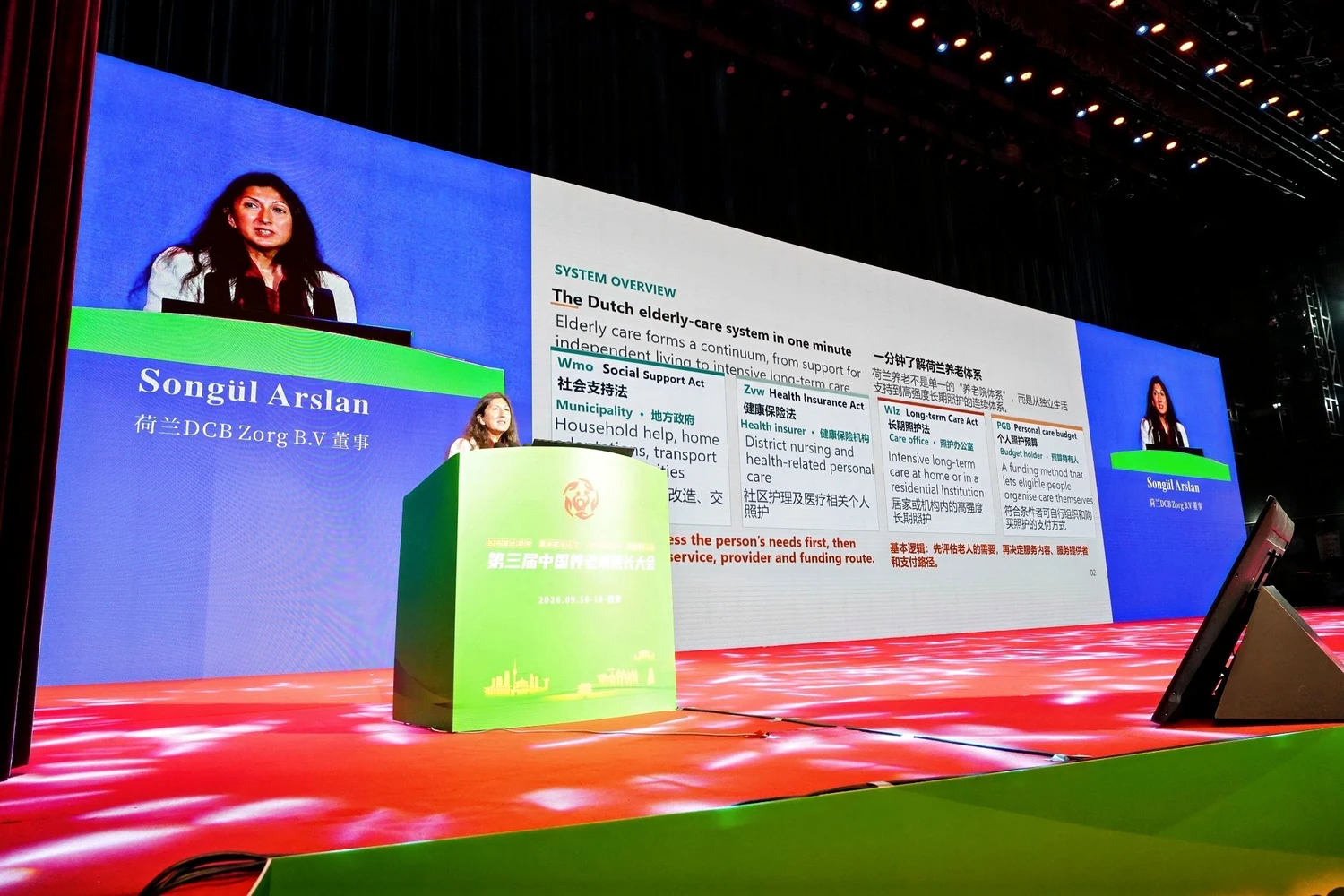
On 16 September 2026, I spoke in Xi’an, Shaanxi, at “Building Consensus · Creating the Future Together”, the Silk Road International Wellness Talent High-Quality Development Exchange Conference. The slide behind me introduced the Dutch elderly-care system through three forms of support: services organised by municipalities, home nursing paid through health insurance and intensive long-term care provided through a separate statutory system.
My presentation materials followed the illustrative journey of Mrs Li, an older woman living alone in The Hague. At 78, arthritis makes stairs and household tasks difficult. By 82, diabetes and reduced mobility mean that she needs help with washing, dressing and medicines. At 86, progressing dementia, night-time wandering and fire risk require a more intensive care arrangement.12
Mrs Li is fictional, but the decisions around her are familiar to any organisation working in a regulated service market. Someone has to assess what she needs, approve the response and identify the budget that will pay for it. A provider must have the staff, authority and contractual basis to deliver the care. Information has to pass safely between organisations, and the buyer eventually has to decide whether the arrangement should continue.
These decisions are more useful to an ageing-related business than a population forecast alone. Demographic change indicates where needs are growing. Commercial demand depends on the organisations and households that can approve, purchase and sustain a response.
Scale does not identify a customer
China reported more than 323 million people aged 60 or over at the end of 2025, representing 23% of its population. National policy defines the silver economy broadly, encompassing care, rehabilitation, home adaptation, technology, financial services, tourism and other products and services for older people and for those preparing for later life.34
That breadth gives businesses many areas to investigate, but the activities within it do not share a single customer or purchasing process. A stairlift purchased by a family may depend on household income, savings or a support programme. Home support commissioned by a municipal authority will be governed by a public budget, eligibility rules and a service specification. A care provider buying scheduling software will consider staff time, integration, reliability and support. An insurer developing a later-life product will assess risk, distribution, claims and the providers available to policyholders.
Adding these transactions together under one market estimate can make the opportunity appear more mature than it is. The number of older people does not reveal how many households can afford a particular service, which residents qualify for public support, which organisations can participate in procurement or whether a buyer will renew the contract.
A business may discover an important social problem, a government priority or a promising application for technology before it has established such a pathway. That discovery is valuable, but further work is required before it can be treated as a source of recurring revenue.
One person can move through several purchasing routes
Mrs Li’s journey shows how the commercial structure changes even though the person receiving support remains the same.
Her first difficulty concerns stairs, household tasks and increasing isolation. A municipal assessment may lead to a home adaptation, household assistance, transport or day activities that help her remain independent. A few years later, diabetes and reduced mobility introduce nursing and personal-care needs. A district nurse assesses what Mrs Li can still manage, where equipment may help and which tasks require professional staff. Municipal support may continue while health insurance pays for the nursing and medically related personal care.
Dementia brings another change. If Mrs Li develops a lasting need for supervision or care close at hand, a separate assessment and funding route may apply. A regional care office then considers whether suitable care can be organised at home or whether residential care is safer.56
The authority making the decision, the source of payment, the provider requirements and the contract all change as her needs intensify. A supplier working with one part of this system therefore needs to understand what happens when the person’s needs exceed the service currently being provided. Additional demand may produce more work, but it may also require another provider, a different agreement or a new assessment before any work can begin.
The practical details are equally important. In one illustrative example, transport to a day activity is scheduled to arrive before Mrs Li’s morning washing visit has finished. Both services have been approved and organised, but their timetables prevent her from using them together. With Mrs Li’s agreement, the proposed solution is for the home-care coordinator to contact the transport service and day centre and arrange a later collection.7
Another example concerns a provider whose insurer agreement does not cover the proposed intensive long-term-care package. More visits cannot simply be added under the existing contract. A provider contracted for the new arrangement must accept the care, interim support may be required and the receiving team needs the information necessary to manage Mrs Li’s wandering, fire risk and supervision needs.8
These examples are commercially significant because they identify the work required to make an approved service usable. If transport arrives too early, Mrs Li misses the activity. If the provider lacks the appropriate agreement, the additional care cannot begin under the existing contract. If the handover omits a safety risk, the receiving team may assign insufficient supervision.
Equipment, software, training or a new care method creates value when it helps the responsible organisations solve one of these problems. The buyer still needs to recognise the problem, fund the response, integrate it into daily operations and see enough benefit to continue paying.
Where apparent opportunities lose commercial shape
National policy often provides the first indication that a field is worth examining. China’s elderly-care reform direction places home-based care at the foundation, community services in a supporting role and institutions as professional backup, with closer links between medical and care services. For a prospective entrant, this makes local home and community services a relevant area of investigation.9
The commercial assessment begins with the local arrangements. A supplier needs to know which authority commissions the work, which residents qualify, what the service specification requires and which providers may participate. It also needs to understand who confirms that the work has been completed, which records must accompany an invoice and when payment is due. These details determine the staffing, cash requirements and responsibilities behind a possible contract.
Technology proposals depend on the same level of clarity. Consider a home-monitoring system designed to alert carers when an older person may need help. The product has to fit the provider’s daily work. Someone must receive the alert, respond outside normal hours where necessary and record what happened. Installation, maintenance, technical support, product classification and data handling all affect the cost and design of the service.
A system intended to save time may increase workload if staff have to enter the same information twice or investigate frequent alerts that require no intervention. A useful pilot therefore tests the operating process as well as the equipment. The parties should agree what will be measured, who will review the result and which decision the evidence is intended to support. That decision may be to purchase, revise, expand or stop.
Conferences and trade missions can help identify the organisations needed for such work. An operator may describe a problem with missed visits, a commissioning authority may be reviewing its requirements, or an insurer may be examining how policyholders obtain care. These conversations become commercially useful when follow-up identifies the person responsible for the issue, the organisation able to approve action and the budget from which the next step could be funded.
The same discipline applies to a pilot. Before work begins, the parties should agree who owns the resulting data, who pays for installation and support, who can authorise continuation and what happens if the work ends. Positive feedback is useful, but a repeatable commercial arrangement requires a defined decision and a customer able to act on it.
What should travel across borders
The Dutch comparison helps distinguish the capabilities an organisation can contribute from the institutional arrangements that must be decided locally.
The fully signed 2025 Dutch elderly-care agreement addresses independence, informal carers, technology, information exchange and administrative work as part of its response to pressure on services. These are policy priorities whose effect depends on implementation, staffing and financing.10
My presentation materials approached China through questions about those choices. Who should fund prevention? Which tasks genuinely require professional expertise? What can families and communities reasonably contribute? Who connects home support, professional care and residential provision as needs change? The purpose was to examine the decisions involved rather than reproduce Dutch institutions.11
A cross-border partnership becomes meaningful when it defines the contribution each party will make. A Dutch care organisation might provide an assessment method, handover protocol or training programme. A technology company might provide equipment, software, installation and technical support. A Chinese operator or authority would determine how those contributions fit local staffing, contracts, professional responsibilities and payment arrangements.
The agreement then needs to identify who changes the operating procedure, who trains the local team, who bears implementation costs, who controls data and intellectual property, how liability is allocated and which results will determine renewal or exit. These terms convert a general intention to cooperate into work that the parties can carry out and govern.
Different partners may perform different roles. An operator can provide staff and a site. A technology supplier can provide equipment and support. A university or specialist organisation may evaluate the outcome. A public authority or insurer may control the purchasing decision. An intermediary may help assemble the parties without being able to commit their budgets or direct their employees.
The De Chinese Brug example in the presentation materials shows a similarly precise role for community relationships. A familiar Chinese-speaking staff member notices that Mrs Li has missed activities and appears increasingly confused, speaks with her and her daughter, and helps them contact a district nurse.
The staff member makes communication easier and helps the family reach the professional responsible for assessment. The district nurse retains responsibility for that assessment. Trust enables access to the formal system, while clear boundaries determine who makes decisions and who carries responsibility for the care that follows.12
Build relationships early, but match commitment to evidence
Emerging opportunities rarely arrive with every budget, procurement route and operating detail already settled. Organisations often need to build relationships before a complete business case exists, particularly where a service is still being designed or a buyer is defining what it intends to commission.
The practical response is to increase commitment in stages. An exploratory visit can reveal how a provider works, identify the authority responsible for a programme or show that the original problem is not a local priority. A workshop can allow the buyer, operator and supplier to define the workflow and the responsibilities involved. A limited pilot can test whether staff can use the proposed response and produce evidence for the next decision.
Each step should answer a question relevant to the commitment that follows. This gives the organisation a reason to continue, revise its approach or stop without treating every discussion as a prospective sale.
Exclusivity, product adaptation, sharing proprietary methods, recruiting employees or establishing a legal entity require stronger evidence than an introduction or exploratory meeting. Before accepting those commitments, leadership should understand the buyer’s authority, the funding conditions, the delivery responsibilities and the terms under which cooperation can end.
Early relationships are valuable when they help establish these facts and create the basis for an agreement both parties can perform.
Six questions before committing resources
A proposal for an ageing-related business should give leadership clear answers to six questions:
- What specific need will change, and how will improvement be observed?
- Which organisation can approve or purchase the response?
- Which household, insurer, public programme or provider budget will pay, and under what conditions?
- Which organisation will run the service, product or process day to day?
- Which professional, regulatory, data, procurement or workflow requirements affect the design?
- Who will review the evidence, and what decision can that person make?
The supporting analysis should name the relevant organisations and decision-makers. It should state the expected price or budget where this is known, identify the delivery owner, describe the principal operating constraints and set a date for reviewing the results. Where an answer remains missing, the next stage of work should be designed to obtain it.
These questions do not remove uncertainty. They make it possible for leadership to distinguish between what has been established, what still needs to be tested and which commitments would be premature.
The presentation materials close with the words:
“Finance should follow assessed need. Care should follow the person.”
Mrs Li gives that principle a practical meaning: she needs to reach her bedroom safely, receive the appropriate help and move between services without losing essential support.
For a business evaluating international expansion, the corresponding task is to establish who can fund and deliver the response, under which agreement and at what cost. A credible growth plan explains how the organisation can repeat that work for the next customer while continuing to meet the responsibilities it has accepted.13
Notes and sources
- Official Alltuu event album, “Building Consensus · Creating the Future Together”—Silk Road International Wellness Talent High-Quality Development Exchange Conference, Xi’an, Shaanxi, 16 September 2026. Accessed 23 September 2026. Photographs credited to PiuFoto. ↩
- Songül Arslan, Financing elderly care in the Netherlands — Mrs Li’s care journey, prepared presentation materials, September 2026. Mrs Li and the management examples are illustrative; the document is not presented as a verbatim transcript. ↩
- China Ageing Association, reporting the 2025 national ageing bulletin, 3 August 2026. ↩
- State Council General Office, Opinion on Developing the Silver Economy and Improving Older People’s Wellbeing, 15 January 2024. ↩
- Arslan, Financing elderly care in the Netherlands, prepared presentation materials; and Government of the Netherlands, Long-term care at home: who is responsible for what? ↩
- Government of the Netherlands, Long-term care at home: who is responsible for what? ↩
- Arslan, Financing elderly care in the Netherlands, prepared presentation materials. The timetable correction is illustrative, not an observed service incident. ↩
- Ibid. The transition and contracting example is illustrative and does not describe an actual provider. ↩
- CPC Central Committee and State Council, Opinion on Deepening the Reform and Development of Elderly-Care Services, 30 December 2024; published 8 January 2025. ↩
- Government of the Netherlands, Elderly-care agreement signed by all parties: care available now and in the future, 15 December 2025. ↩
- Arslan, Financing elderly care in the Netherlands, prepared presentation materials. The section invites examination of the decisions involved rather than replication of Dutch institutions. ↩
- Ibid. The community example is illustrative and is not presented as a verified client history or measured outcome. ↩
- Ibid. The closing words are attributed to the prepared presentation materials; no recording or transcript is used to claim verbatim spoken delivery. ↩